
Disclosure: Some links on this page are affiliate links to Ikigai Daily’s own products (e.g., the Ikigai Life Design System on Gumroad). If you purchase through these links, we may earn a commission at no extra cost to you.

I started shinrin-yoku because I had a sleep problem.
It was 2018, and I was working long hours in Tokyo, going home in the dark, scrolling on my phone in bed, and waking up tired. A friend who had moved to the countryside told me about something she called 森林浴, forest bathing. It sounded vague and a little embarrassing. But she gave me one rule: walk for 30 minutes in a green place, leave your phone in your pocket, and pay attention.
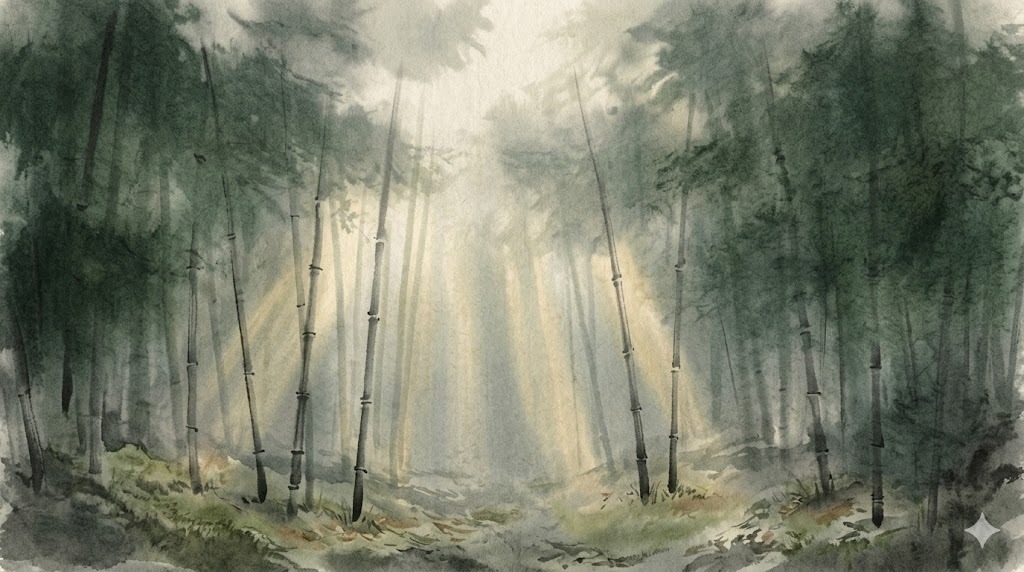
The closest green place to me was a small public park three blocks from my apartment, with mature ginkgo and cherry trees that filtered the morning light into long pale shafts. So that’s where I started, on Sunday mornings, before the children’s voices arrived. By the third week, I noticed I was sleeping better, settling into bed without scrolling first. By the third month, the practice had a name in my head, and I had read enough Japanese forestry research to know I had stumbled into something the Japanese government had been quietly recommending for forty years.
This guide is for anyone curious about what shinrin-yoku actually is, what the science actually shows, and how to do it from a city without a single mountain in sight.
What shinrin-yoku actually means
Shinrin-yoku is the Japanese practice of spending unhurried, screen-free time among trees, paying attention with all five senses. The word translates as “forest bathing,” and the practice was named by Japan’s Forestry Agency in 1982.
The Japanese word 森林浴 (shinrin-yoku) is built from 森林 (forest) and 浴 (yoku, “to bathe in”). Yoku is the same character used in 日光浴 (nikkou-yoku, sun bathing) and 海水浴 (kaisui-yoku, sea bathing). It does not mean swimming. It means immersing yourself in the atmosphere of something, letting it touch you, change your breathing, slow your pulse.
The term was coined in 1982 by Tomohide Akiyama, then Director-General of the Japanese Forestry Agency. The agency held a public event in Nagano prefecture, in a forest of 200-year-old cypress trees, and the term was introduced to the press as part of a broader national health initiative (Akiyama 1982, see Miyazaki 2018 for the institutional history). Japan was at the height of its bubble economy. Tokyo office workers were sleeping at their desks. Akiyama’s bet was simple: Japan’s forests covered two-thirds of the country and almost nobody was using them, and there was a hypothesis worth testing, that breathing forest air was measurably good for the human body.
When the term traveled to English-language readers, the most common translation was “forest bathing.” It is technically correct but slightly misleading. To bathe, in English, suggests submerging. The Japanese sense is closer to “soaking in the air of.”
Also on Etsy: the same planners and singles, in the Ikigai Daily Studio shop.
Why Japan made forest bathing official policy
Most of the practical context behind shinrin-yoku makes more sense if you remember Japan in the early 1980s. The country was in the middle of an economic boom, with workers commuting two hours each way, working until 10 or 11 at night, and showing measurably high rates of stress-related illness. The expression 過労死 (karoshi, “death from overwork”) entered the medical literature around the same time as shinrin-yoku entered the policy literature. The two are not unrelated.
The Forestry Agency had a second reason. Two-thirds of Japan is forested, but most of those forests are commercial cypress and cedar plantations, and the rural communities that managed them were losing population to the cities (Imai 2013). A national program that brought urban Japanese into rural forests would, the ministry hoped, generate both health and a small flow of money to the countryside. So shinrin-yoku was launched not just as a health idea but as a piece of regional policy.
The first physiological experiment on the practice was conducted in 1990 in Yakushima, a forested island off the southern coast of Japan, with five male university students. Researchers measured cortisol in saliva, heart rate, blood pressure, and pulse rate before and after a forest walk. Cortisol dropped. Heart rate dropped. The findings were modest, the sample was tiny, and the methodology was rough by today’s standards. But it was a starting point.
In 2004, Chiba University established the Center for Environment, Health, and Field Sciences, and the Japanese Society of Forest Therapy was founded the same year (Miyazaki 2018, p. 14). Evidence-based research on shinrin-yoku began in earnest. By 2026, there are roughly sixty officially designated 森林セラピー基地 (forest therapy bases) across Japan, each with a guide network and measured walking trails.
What the science actually shows
Two researchers shaped the modern field.
The first is Dr. Yoshifumi Miyazaki at Chiba University, who has run dozens of small-scale field trials measuring what happens to the body during a forest walk versus a city walk. His core finding is consistent: salivary cortisol drops, sympathetic nervous system activity drops, parasympathetic activity rises. In plain language, your body shifts out of fight-or-flight (Miyazaki 2018).
The second is Dr. Qing Li at Nippon Medical School, who studies the immune system effects. In a series of studies, Li and colleagues found that participants who spent 2-3 days walking in forests showed significantly increased Natural Killer cell activity, a marker of immune system function (Li 2010). The effect persisted for up to 30 days after the trip. Li traced part of the mechanism to phytoncides, volatile organic compounds emitted by trees, especially cypress and cedar, that humans inhale as part of forest air.
Phytoncides are not a single compound. They are a family. The two most studied in the shinrin-yoku literature are alpha-pinene, the compound that makes pine and cypress smell like pine and cypress, and D-limonene, present in citrus and some conifers. Both have been shown in lab settings to suppress certain bacterial growth and to influence parasympathetic nervous system tone. The original observation that trees emit antimicrobial volatile compounds came not from Japan but from a Soviet biochemist named Boris Tokin, working in the 1930s and 1940s on what he called phytoncidy. Japan picked up the lineage, ran with it, and built a forty-year national program around it.
What the research is most consistent on is short-term mood improvement. Even single sessions reduce self-reported anxiety and improve mood, and these findings have been replicated across cultures including South Korea, Finland, and the United States.
The honest limits of the research
A few qualifiers belong here, because the popular literature on shinrin-yoku has gotten ahead of the evidence in places.
The studies are mostly small. Many have fewer than thirty participants. Effect sizes vary from one trial to the next. Most research has been done on Japanese subjects in Japanese forests, with cypress and cedar dominating the canopy, and we don’t know how much of the effect generalizes to other tree species or other populations. Some of the immune studies have not been independently replicated outside the original research group.
What the literature is not is proof. Forest bathing does not cure cancer, prevent dementia, or replace medical care. It is one practice among many, with measurable but modest physiological effects. If you are immune-compromised, work outdoors already, or live in an area with high tick-borne disease prevalence, your relationship to “more time in trees” is more complicated than a 30-minute Sunday walk in a city park, and is worth a real conversation with your doctor.
The most honest summary I have read of the current state of the science comes from Miyazaki himself, who reminds readers that shinrin-yoku is best understood as preventative care, not therapy in any prescriptive medical sense.
What shinrin-yoku is not
The first time I tried to explain shinrin-yoku to a friend, he said “oh, like hiking.” It is not.
Hiking has a destination. Shinrin-yoku does not. You walk slowly, often less than one kilometer in an hour, sometimes sitting still for ten or fifteen minutes. Exercise heart rates are not the goal. If you are out of breath, you are doing something else.
It is also not nature photography. Photography requires you to look for compositions, to think about exposure, to be partly outside the scene. Shinrin-yoku asks you to be inside the scene.
And it is not aromatherapy, though phytoncides do play a role. The practice involves all five senses, not the nose alone. The smell of damp soil, the texture of bark, the sound of wind in needles, the green light filtered through leaves, even the slightly metallic taste of cool forest air all matter.
How to practice it without going to a remote forest
For people who live in cities, the best entry point is a small park with mature trees within walking distance of home. You do not need a national forest. Tokyo’s Yoyogi Park, London’s Hampstead Heath, New York’s Prospect Park, Berlin’s Tiergarten, these all work. So does a quiet residential street with old plane trees, if that is what you have.
The minimum effective dose, based on Miyazaki’s lab studies, appears to be about 20-30 minutes. The recommendation in most Japanese forest therapy bases is 60-120 minutes for a session, but if 30 minutes is what fits in your week, 30 minutes is what you do.
A simple sequence I have used:
For the first five minutes, walk at half your normal pace. Notice the feeling of your feet on the ground.
For the next ten minutes, stop attending to where you are going and start attending to what is around you, the colors of the leaves, the temperature of the air on your face, the small noises you can hear under the city background.
For the final fifteen minutes, sit still on a bench or against a tree. Watch one small thing for as long as you can. A leaf. An ant. The way light moves across a patch of bark.
Leave your phone on airplane mode in your pocket the whole time.
How forest bathing has spread beyond Japan
The practice has been picked up well outside Japan, sometimes with new names attached.
In South Korea, the equivalent practice is called 산림치유 (sallim chi-yu, “forest healing”), and the Korean Forest Service has built more than 30 official “healing forests” with similar protocols to the Japanese model. Korean researchers have replicated several of the cortisol and parasympathetic findings in Korean populations.
In Finland, where roughly 75% of the country is forested, the practice has been called luontolähtöinen menetelmä (nature-based methods) and integrated into rehabilitation medicine and elder care. The cultural baseline of “going to the forest to feel better” was already there. The term and the dosing protocol came from Japan.
In the German-speaking world, Waldbaden has become a small private industry, with certified guides and corporate retreat offerings. German forest medicine researchers have begun small clinical trials.
In the United States, the National Park RX program, launched in 2013 with the Park Service and the National Recreation and Park Association, formalized doctor’s prescriptions to time in nature. The International Society of Nature and Forest Medicine (INFOM), founded in 2011, has been the international hub for connecting these national efforts.
The point is that shinrin-yoku is no longer a Japanese export. It has become a multinational, multi-cultural set of practices, and Japan is one node in a wider conversation about the health value of unhurried time in trees.
Where it fits with the other Japanese practices
Most of what I write about on Ikigai Daily concerns the slow, intentional way of living that runs through Japanese practical philosophy. Shinrin-yoku is the somatic and ecological pillar of that framework.
Ikigai (生き甲斐) gives you a sense of why you are doing what you are doing. Wabi-sabi (侘び寂び) trains you to accept the imperfection and impermanence of what you have. Kaizen (改善) is the discipline of small steady improvements. Kakeibo (家計簿) is mindful attention applied to money. Japanese minimalism is mindful attention applied to your physical environment. Shinrin-yoku is mindful attention applied to your body in nature.
These are not six separate philosophies. They are six entry points into the same posture: pay attention, choose deliberately, accept what you cannot change, keep the body in the loop.
A simple weekly practice
If you want to integrate shinrin-yoku into your weekly rhythm, here is the most boring, repeatable version.
One 30-minute session per week, in the same green place, on the same morning. No watch. No phone. No goal.
That is it. The benefit is real but slow. After six to eight weeks, most people I know who have tried it report sleeping better, feeling slightly less reactive, and having a small mental “place” to return to during stressful days at the office.
If you keep a Notion journal or use the Ikigai Life Design System for daily entries, a single line, “Forest walk: 30 min, X park,” is enough to build the habit. The act of writing it down doubles its retention.
The Ikigai Life Design System I built and use myself has a daily entry field for “one thing that gave me life today” and another for “ikigai-aligned hours.” On the days I do my forest walk, both fields fill themselves: the walk gave me life today, and 0.5 ikigai-aligned hours gets logged. Over the months, the system stops being a tracking chore and becomes a quiet record of the rhythms that actually matter, including the Sunday mornings under the ginkgo trees. The full version of this walk, reduced to what can be done on a lunch break near wherever you already are, is in Shinrin-Yoku Without a Forest: The 30-Minute Version.
Common questions about shinrin-yoku
Is shinrin-yoku the same as hiking? No. Hiking has a destination and raises your heart rate. Shinrin-yoku is slow and has no goal. You often walk less than a kilometer in an hour.
How long should a session be? Lab studies suggest 20 to 30 minutes is the minimum effective dose. Japanese forest therapy bases recommend 60 to 120 minutes, but a short weekly walk is better than none.
Do you need an actual forest? No. A small city park with mature trees works. The practice is about unhurried attention, not the size of the woodland.
What does the science actually show? The most consistent finding is short-term stress and mood improvement. Effects on immune markers exist in the research but come from small studies. It is preventative care, not medical treatment.
If you want to keep the walks on paper: the Shinrin-Yoku Log is thirty-five pages, one for each walk, with a line for each of the five senses and a reading at the end. A4, A5, and Letter. $6.
Where to read further
For the philosophy, Yoshifumi Miyazaki’s Shinrin-Yoku: The Japanese Art of Forest Bathing (Miyazaki 2018) remains the most readable English-language entry point. For the immune system science, Qing Li’s Forest Bathing: How Trees Can Help You Find Health and Happiness (Li 2018) summarizes the NK cell research at popular-audience level. For the wider cultural and Western adoption, Florence Williams’s The Nature Fix (Williams 2017) is the journalistic counterpart. For the one-minute version under a single tree, Komorebi. And for the season the research itself chose, Shinrin-Yoku in Autumn.
To see how shinrin-yoku integrates with the other Japanese practices, the What Is Ikigai complete guide is the connecting essay, with Wabi-Sabi, Kaizen, Kakeibo, and Japanese Minimalism covering the other five pillars.
If you want to track the practice alongside ikigai-aligned hours, energy, and intentions, the Ikigai Life Design System on Gumroad is the Notion template I use myself.
Continue Reading: Get the Ikigai Life Design System on Gumroad ($39 USD)
A free starter guide. New to ikigai? Start with our free PDF, What Ikigai Actually Means. It covers what the word really means (and why it is not a Venn diagram), the Japanese research behind it, and one small practice for tonight. You get it by email, free. → Get the free guide
About the author. Yu Suda writes about Japanese philosophy and intentional living from Tokyo. He reads the texts referenced in his work in the original Japanese, and most articles on Ikigai Daily draw on Japanese-language sources alongside the standard English translations. He is the founder of Ikigai Daily, a publication on Japanese philosophy and a small product line of life design tools used by readers around the world.