
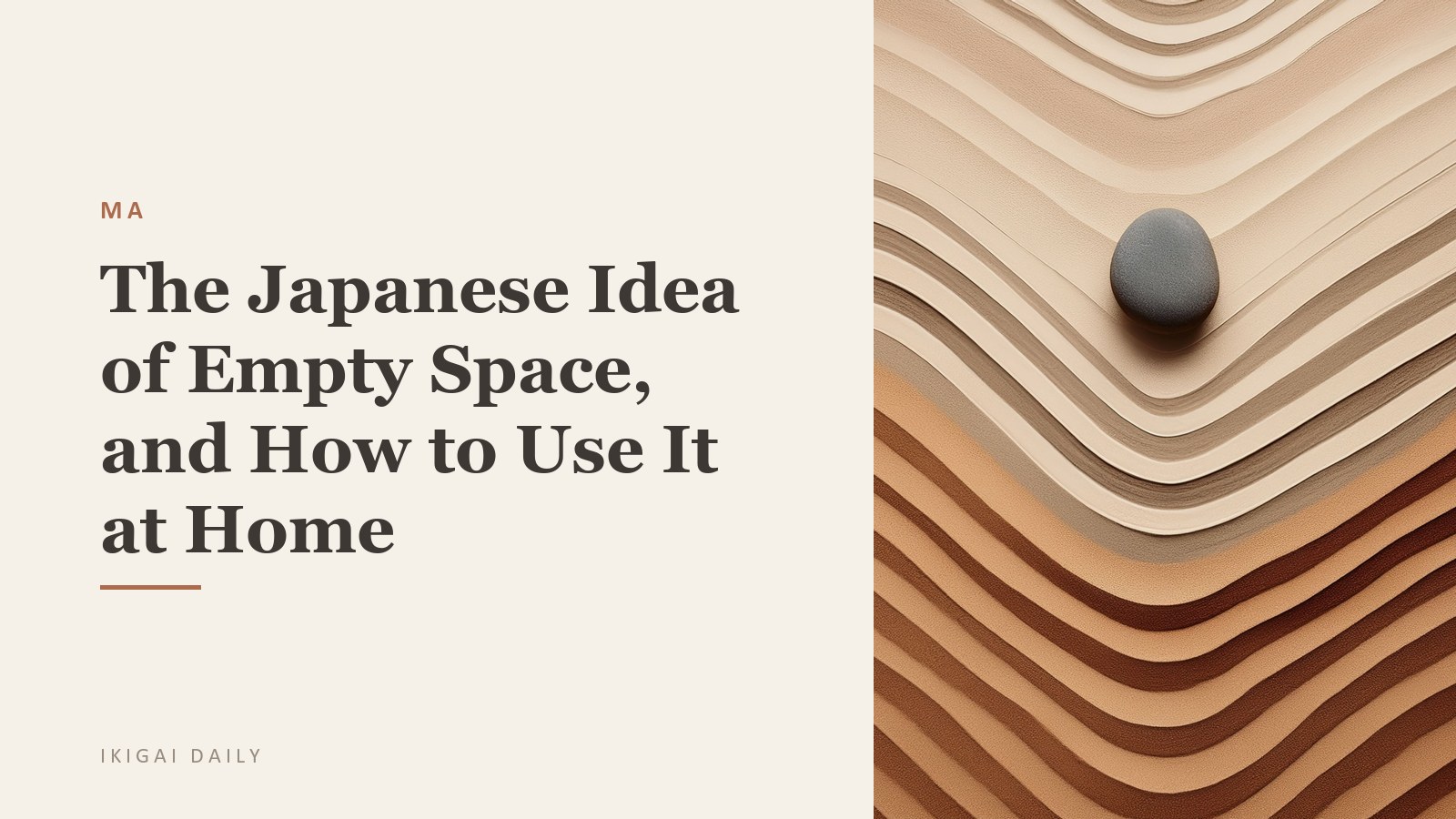
Ma is the Japanese word for the space between things. The pause between two notes, the gap between two stones in a garden, the empty part of a room. It is written with the character for a gate with the sun showing through it, and it means an interval that is not nothing, but something: a gap that is part of the design.
Most Western rooms are planned by what goes in them. A room planned with ma in mind is also planned by what is left out.
Space as a material
In a traditional Japanese room the floor is mostly empty. Furniture is low and little, and much of it is put away when not in use. The eye is not met by objects everywhere it turns. It rests.
This is not minimalism as a style. It is the use of empty space as a material in its own right, like wood or paper. The emptiness is doing a job: it gives each object around it room to be seen, and it gives the person in the room somewhere to be.
Also on Etsy: the same planners and singles, in the Ikigai Daily Studio shop.
Where ma shows up
In music, ma is the silence between notes, which gives the notes their shape. In conversation it is the pause before an answer, which in Japanese is not awkward but respectful. In ink painting it is the paper left untouched, often most of the sheet. In the tea room it is the single object in the alcove, with nothing beside it.
In every case the empty part is placed as carefully as the full part.
One surface
The simplest way to bring ma into an ordinary home is to choose one surface and keep it empty. A table, a shelf, the top of a chest of drawers. Not decorated with fewer things. Empty.
Clear it once, properly. Then, for a week, put nothing on it. Watch how often something tries to land there: post, keys, a cup. Each time, move it on. By the end of the week the surface has become a small quiet place in the room, and the room feels different for it.
One wall
The same can be done with a wall. Most rooms have one wall that carries too much: pictures, shelves, a calendar, a clock. Take everything off it. Live with the empty wall for a few days before deciding what, if anything, goes back. Often the answer is one thing, placed lower and more to one side than expected, with space around it.
Ma in time
Ma is not only about rooms. A day can have empty space in it too: ten minutes between finishing one thing and starting the next, without a screen. A morning that does not begin with a list. In Japanese daily life these pauses are built in, in the small rituals of making tea or sweeping a step, which are really a way of leaving a gap between one part of the day and the next.
Why it is hard
Empty space asks to be filled. A clear table attracts things; a clear hour attracts tasks. Keeping ma means saying no, quietly, many times a day. That is the practice, and it is the same practice as danshari, the Japanese discipline of refusing what comes to the door.
The reward is a room, or a day, with somewhere to rest in it.
A free three-month log. Let One Thing Age gives you three months to watch one object change, and a line a week to write down what you see. You get it by email, free. → Get the free log
Continue Reading
This article is part of a series exploring Japanese philosophy and intentional living: