
Disclosure: Some links on this page are affiliate links to Ikigai Daily’s own products, such as the Ikigai Life Design System on Gumroad. If you buy through one of these links, we may earn a small commission at no extra cost to you.
Most homes have a drawer or a cupboard with something broken in it. A favorite mug with the handle snapped off. A bowl that came apart in the sink. We keep these things for a while, half meaning to fix them, and then one day we decide they are not worth the trouble and throw them out.
Kintsugi is the Japanese practice that interrupts that small, ordinary decision. Instead of hiding a repair or discarding the object, it mends the break with lacquer and metal and leaves the seam showing. The result is an object that is openly, deliberately mended, and often more striking than it was before it broke.
What kintsugi actually is
The word kintsugi (金継ぎ) means “golden joinery.” A closely related term, kintsukuroi, means “golden repair.” Both name the same craft: mending broken pottery with urushi, the natural lacquer tapped from the Japanese lacquer tree, and finishing the repair by dusting or mixing the final layer with powdered gold, silver, or platinum.
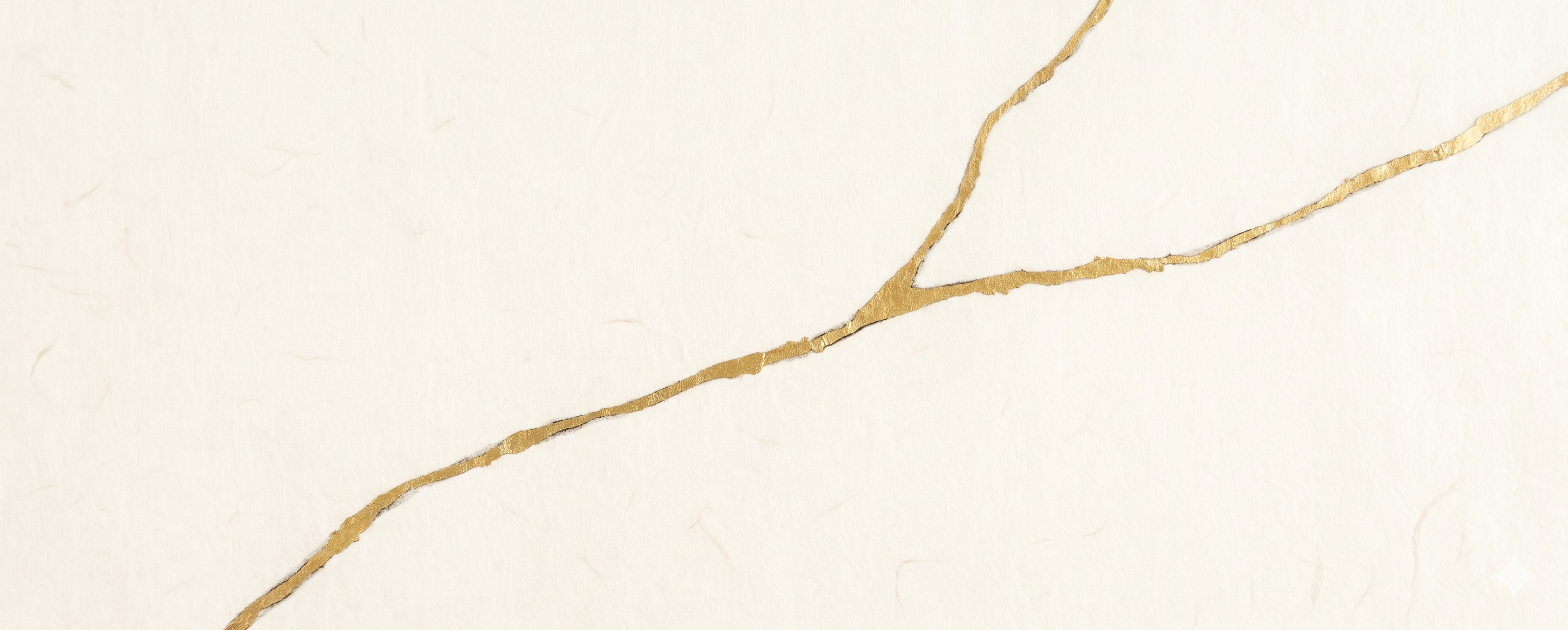
The metal is the part everyone notices, but it is not the part that matters most. The defining choice in kintsugi is to make the repair visible. A kintsugi bowl does not pretend to be undamaged. The crack runs across it as a bright line, and the object’s history of breaking and being mended becomes part of how it looks. Kintsugi is sometimes described as a kind of invisible mending. It is the opposite of that. It is mending that asks to be seen.
Also on Etsy: the same planners and singles, in the Ikigai Daily Studio shop.
The bowl that started the story
The origin story usually told centers on a single object. In the fifteenth century, the shogun Ashikaga Yoshimasa owned a prized Chinese tea bowl, a celadon piece, that developed a crack. He sent it to China hoping to exchange it for one of the same quality. China could no longer produce celadon that fine, so the bowl came back as it had gone, with the crack now fastened by metal staples driven across the break. It survives today, and it carries a darkly funny name: Bakōhan, a reference to large locusts, because the rows of staples looked like insects clamped onto the surface.
Here the popular story and the documented record part ways, and the gap is worth noticing. The popular version says Yoshimasa was disappointed by the ugly staples and asked Japanese craftsmen for something better, and that kintsugi was born from his dissatisfaction. The record is smaller and, in a way, more interesting. The Bakōhan bowl is real and can be seen in the Tokyo National Museum, and far from being discarded it became more prized because of its visible repair, not in spite of it. There is no firm evidence that this particular bowl led directly to the invention of kintsugi. What the episode actually shows is a sensibility already taking shape: a repair you could see was not a disgrace, and could even be part of why an object mattered. Kintsugi refined that sensibility into a craft.
Kintsugi grew up alongside the Japanese tea ceremony, where a humble, aged, or imperfect object could be prized rather than dismissed. By the time of the tea master Sen no Rikyū in the sixteenth century, the aesthetics of the tea room valued restraint and age over the polished and the new. A mended bowl was not a lesser bowl. In her book Kintsugi: The Poetic Mend (2021), Bonnie Kemske describes how the repair came to be valued in its own right, to the point where collectors were sometimes said to have broken pieces deliberately so that they could be mended. Whether or not that last detail is literal, it shows how far the idea travelled. A repair could add value rather than subtract it.
Three ways to mend
Kintsugi is not a single move. Restorers generally work in one of three ways, depending on what the break has left behind.
The first and simplest is the crack repair. The pieces still fit together, so they are rejoined and the seam is traced in gold. This is the image most people picture: a bowl veined with thin gold lines.
The second is used when a fragment is missing entirely. The gap is filled with a built-up compound of lacquer, shaped and smoothed until it sits flush with the surrounding surface, and then finished in gold. The result is a small golden patch, a part of the bowl that is openly not the original clay.
The third is the most surprising, and it has its own name: yobitsugi (呼び継ぎ). Here a missing piece is replaced not with lacquer but with a fragment from a completely different vessel, often one with a different glaze, color, or pattern. The mended bowl becomes a deliberate collage of two histories. Yobitsugi makes the underlying attitude of kintsugi unmistakable. The object is not being returned to an imagined original state. It is being allowed to become something new.
The ideas behind it
Kintsugi sits close to three Japanese ideas, and it is worth naming them clearly.
The first is wabi-sabi, the aesthetic that finds beauty in imperfection and in the passing of time. Leonard Koren, in Wabi-Sabi for Artists, Designers, Poets and Philosophers (1994), describes wabi-sabi as the beauty of things modest and unconventional. A kintsugi bowl is that idea made literal. The flaw is not tolerated. It is the point.
The second is mottainai, a feeling of regret at waste. To mend a thing rather than throw it away is, in part, a plain ethical reflex, and it places kintsugi alongside older habits of care and repair that most cultures once had and many have since lost.
The third is harder to put into English. Mushin (無心), often translated as “no mind,” names a kind of acceptance. Writing in the exhibition catalogue Flickwerk: The Aesthetics of Mended Japanese Ceramics (2008), the scholar Christy Bartlett connects kintsugi to mushin and to a calm acceptance of change and of fate. Behind it sits the older Buddhist sense of mujō, the impermanence of all things. The break happened. It belongs to the object now. The repair does not pretend otherwise. It works with the break rather than against it.
This is also the point where a clear-eyed guide has to slow down. Over the past decade, kintsugi has become a popular metaphor in Western self-help. Embrace your scars. Your cracks are where the light gets in. You are more beautiful for having been broken. There is something true in this, and it is not wrong to be moved by it.
But the metaphor, used on its own, can flatten the practice. Kintsugi is not a mindset, and it did not begin as one. It is a craft with specific materials, a long working time, and a real cost in patience and attention. The philosophy is genuine, but it was discovered through the doing, by people repairing actual bowls over actual months. If you keep only the inspirational caption and drop the craft, you keep the smallest and least demanding part of what kintsugi is.
What it is like to do
Traditional kintsugi is slow, and the slowness is not a flaw in the method. It is the method.
Urushi lacquer does not dry in the ordinary sense. It cures by taking up moisture from humid air, which is why practitioners keep their work in a muro, a humidity box, between stages. A traditional repair moves through several of those stages. The broken edges are cleaned. They are joined with mugiurushi, an adhesive made by mixing urushi with wheat flour. Gaps and missing slivers are filled with sabiurushi, urushi mixed with a fine clay powder, then smoothed once it has hardened. Thin layers of lacquer are built up over the seam and left to cure. Only at the very end is the metal applied, using the maki-e technique of sprinkling fine gold or silver powder onto a final tacky layer of lacquer, which is then left to set and gently burnished.
Between most of these steps the piece simply rests, sometimes for days, sometimes for weeks. A full repair can take well over a month. Raw urushi adds one more reason for care. It can cause a poison-ivy-like skin reaction in people who are sensitive to it, since it comes from the same family of plants.
This is worth knowing, because the kintsugi kits widely sold online usually do not use urushi at all. Most use a synthetic epoxy or adhesive mixed with gold-colored powder. These kits are faster, cheaper, and far more forgiving, and there is nothing wrong with starting there. Two honest caveats apply. Synthetic kits are generally not food-safe, so a bowl mended that way is best treated as a decorative object rather than something you eat or drink from. And the result, lovely as it can be, is closer to a kintsugi-style repair than to the traditional craft. If you later want the real thing, traditional urushi kits and classes exist, and they ask for exactly the patience the material demands.
If you want to begin, the gentlest start is a piece you already own and would otherwise throw away. A clean break into a few large pieces is much easier to work with than a shatter. Set aside more time than you think you need, accept that your first repair will look like a first repair, and notice that this, in a small way, is the entire point.
Why it lasts
Kintsugi endures because it answers a question most of us meet often and rarely stop to think about. What do you do with something that has broken? The ordinary answers are to hide the damage or to throw the thing away. Kintsugi offers a third answer. Keep it, mend it, and let the mend show.
The object that comes back from a kintsugi repair is not the object you had before. It carries its history on the surface, in a line of gold. Whether you take a larger lesson from that is your decision to make, not something a bowl can decide for you. The practice itself asks only one thing, and asks it patiently: that you treat a broken thing as still worth your time and care.
If that way of paying attention appeals to you, it is close to the attention our Ikigai Life Design System asks you to bring to a life rather than a bowl. Noticing what is worth keeping, repairing what can still be repaired, and being honest about what has changed.
About the author. Yu Suda writes about Japanese philosophy and intentional living from Tokyo. He reads the texts referenced in his work in the original Japanese, and most articles on Ikigai Daily draw on Japanese-language sources alongside the standard English translations. He is the founder of Ikigai Daily, a publication on Japanese philosophy and a small product line of life design tools used by readers around the world. If you want to try the idea without lacquer or gold, Kintsugi Without the Gold is one broken thing, mended so the mend shows.
A free three-month log. Let One Thing Age is a four-page sheet for one object you already own: the rule, twelve weekly lines for what you notice, and one question for the end. You get it by email, free. → Get the free log
If you want the idea on a wall: the Kintsugi set of four at IkigaiDailyStudio, printable in four ratios. There is a sage green version too.