
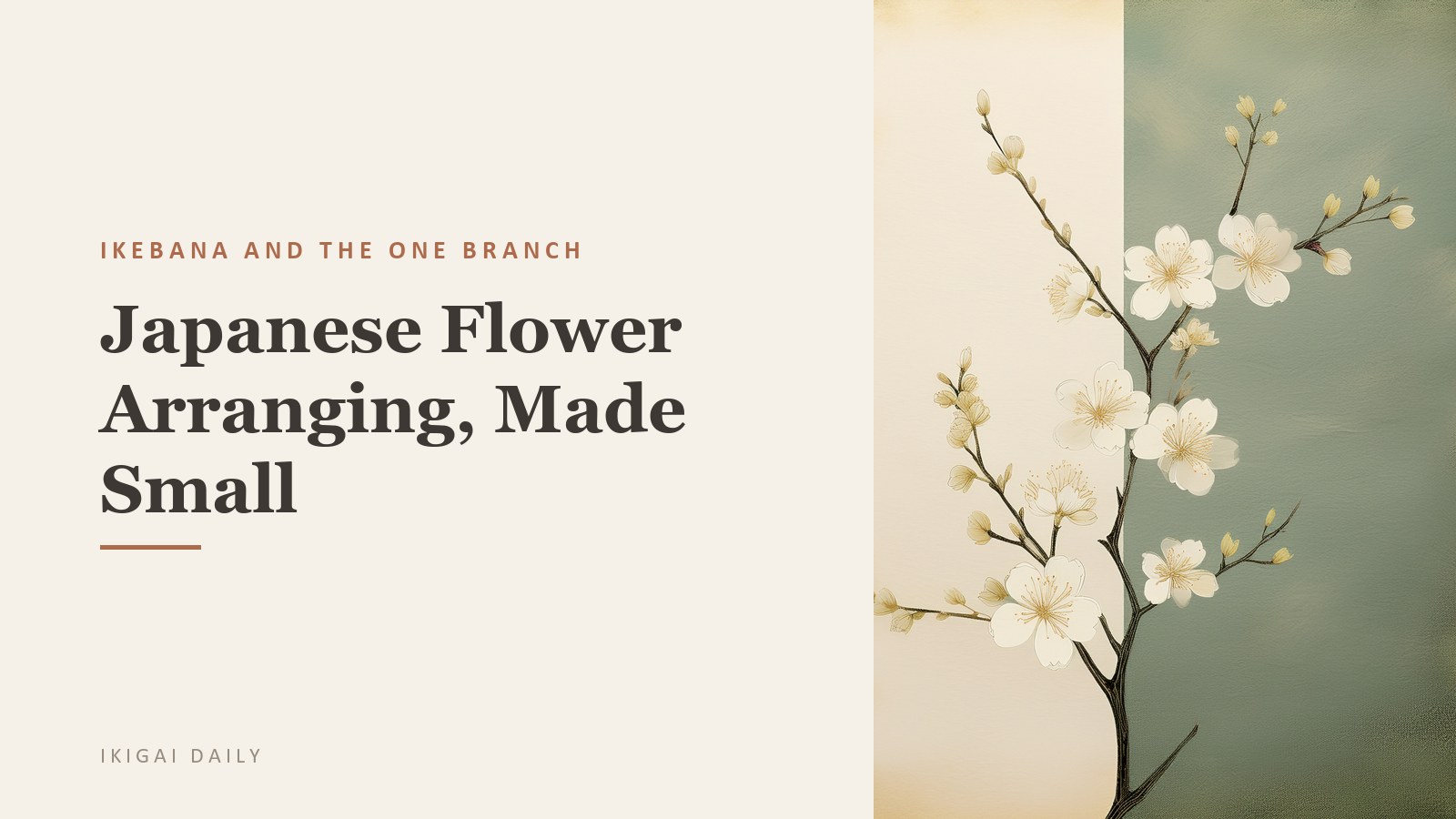
Ikebana is the Japanese art of arranging flowers, and the word is usually translated as living flowers. Western flower arranging tends to fill a vase. Ikebana tends to empty it: a few stems, a branch with its leaves thinned out, a great deal of space left on purpose around them.
The art has schools, ranks and centuries of rules. Its core idea fits on a kitchen table with one branch in a cup.
Where it comes from
Ikebana grew out of flower offerings at Buddhist altars, which came to Japan with Buddhism in the sixth century. By the fifteenth century arranging had become an art in its own right, practised by monks and displayed in the tokonoma, the alcove of a formal room. The oldest school, Ikenobo, is based at the Rokkakudo temple in Kyoto and traces its records back to the 1460s.
Over the following centuries the styles multiplied. Rikka was large and formal, built to represent a whole landscape. Shoka, also called seika, reduced that to three main lines. Nageire, the thrown-in style, was looser and suited the tea room. In the late nineteenth century the Ohara school developed moribana, arrangements in a shallow dish that made room for Western flowers. In the twentieth century Sogetsu opened the art to any material at all.
Through all of them, a few ideas stayed the same.
What stays the same
Line comes before mass. An arrangement is read as a shape drawn in the air by stems and branches, not as a quantity of colour. One curving branch can carry the whole thing.
Asymmetry is the rule. The classic three-line structure gives each stem a different height and angle, often described as heaven, earth and person, or with other names depending on the school. None of them is placed in the centre.
The empty space is part of the arrangement. The gap between two stems, and the space around the whole, are designed as carefully as the stems. This is ma, the Japanese sense of negative space, applied to a vase.
The season is visible. A spring arrangement uses budding branches; an autumn one may use a branch with a few coloured leaves left on it. A seed head, a bare twig or a half-open bud is often preferred to a flower at its peak, because it shows time passing. That preference is wabi-sabi in plant form.
The one-branch version
No kenzan, the spiked holder, is needed for this. A cup, a jar or a narrow vase will hold one branch at an angle against its rim.
Choose one branch or stem from outside or from the cheapest bunch at the shop. A branch with a bend in it is better than a straight one.
Cut away more than feels right. Remove leaves that cross each other, side shoots that compete with the main line, and anything below the water. Ikebana teachers describe much of the work as subtraction.
Set it at a slant rather than upright, and turn the vessel until the branch makes the best line against the wall behind it. Then leave an empty area beside it: no other objects within an arm’s width.
Change the water every day or two and watch what the branch does over a week. Leaves fall, buds open, the line changes. In ikebana that change is the point, not a problem to be fixed.
Also on Etsy: the 2027 Micro-Seasons Desk Calendar ($3.99) and the same planners, in the Ikigai Daily Studio shop.
For a home outside Japan
The materials do not need to be Japanese. Hedge clippings, a stem of rosemary, a single dried grass or a branch from a fallen bough all work. What transfers is the attitude: fewer stems than you think, a line instead of a bunch, space left on purpose, and an arrangement that shows what week of the year it is.
One branch in a cup is the smallest form of the art. It is also, many teachers say, the hardest to get right, because there is nothing to hide behind.
A free three-month log. Let One Thing Age gives you three months to watch one object change, and a line a week to write down what you see. You get it by email, free. → Get the free log
Continue Reading
This article is part of a series exploring Japanese philosophy and intentional living: